


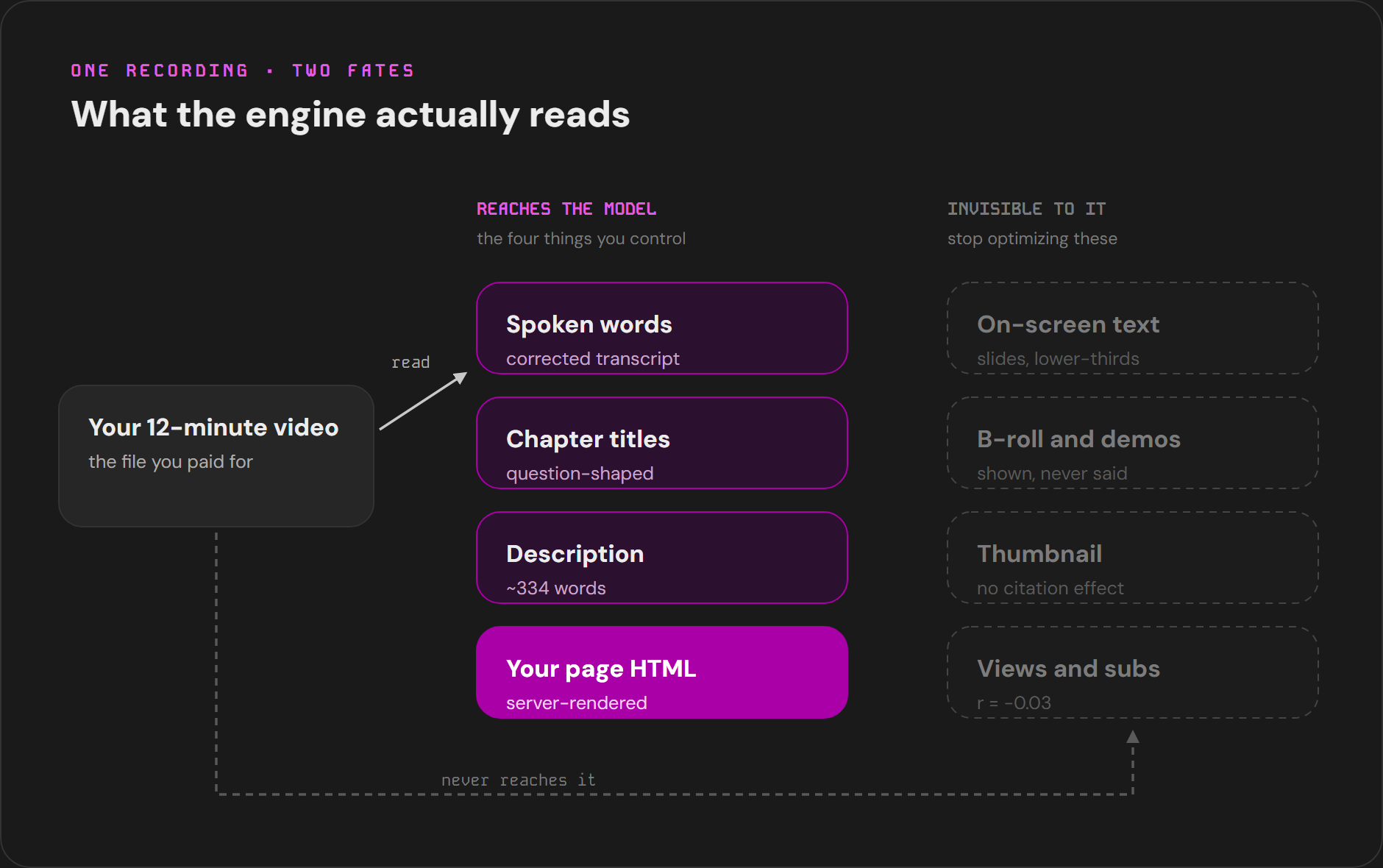
No AI answer engine watches your video. ChatGPT reads the transcript. Perplexity reads the transcript. Claude cannot open YouTube at all and only knows your video exists if somebody wrote about it. Google's stack runs on a multimodal Gemini that could analyze video frames, but at the time of writing this, it doesn't.
Optimizing video for AI citation is a little counterintuitive since it's not a video job...
Make it Long and Answer ONE Question
Long-form takes 94.3% of AI video citations. Shorts get 5.7%. According to Otterly's data, the sweet spot is 10 to 20 minutes, followed by 5 to 10.
Views do not matter (!!!). The correlation between a video's view count and how often it gets cited is -0.03, and 40.8% of cited videos had under 1,000 views. Subscribers, likes, and channel size do very little (if anything) for AI visibility.
AI citations aren't a popularity contest, so popularity has no weight in the selection process. It is "what is the most likely most relevant answer to this question" reference.
What does it mean for you? Pick ONE real question your audience asks and answer it completely. This format is most likely going to be boring for a human audience and will never go viral - that also means there's very little competition out there doing it purely for AI citations.
Script Matters More Than The Video
The transcript is what gets quoted, so write your script like an article optimized for AI citations.
Here's an example of what's bad for AI, and perfectly normal for humans: "As you can see right here, this new one is way faster than the old model".
In the video, that is fine. You are pointing at the thing, showing slides, screenshots, scrolling pages, etc. When transcribed, it says nothing at all. There's no product, numbers, pretty charts, and no context for an AI model to care about.
A script optimized for AI citation would look more like this: "The Acme Rocket 3 renders 4K video in eight seconds, three times faster than the Rocket 2".
Same information for the human (you can still show all pretty visuals) and completely different context for the machine.
Follow those three simple rules:
- Say every entity out loud - That means YOU HAVE TO NAME THE BRAND! Ahrefs study defines a "YouTube mention" as your brand appearing in the title, transcript, or description. If your product/brand name was presented as a graphic or text on the screen, it's invisible to AI.
- Don't use "pointing" words - "This", "that", "here", "as you can see". You need to be conscious of what you say VS what you show.
- Start with an answer, explain later - Open each section by stating the question and answering it in one, self-contained sentence. Most of the time the engine takes the isolated sentence, not the paragraph, so it has to stand on its own.
The only rigorous study in this field, the GEO paper from KDD 2024, tested nine methods across roughly 10,000 queries. Quotations lifted visibility 41%. Statistics, 31%. Citing sources came in just behind. Keyword stuffing scored negative 8%, so don't try to be "old school black hat" clever here ;)
That study was about text, and your video is still seen as text by the model (transcript -> text), so talk the way you would write with GEO in mind: attributed, quotable, numbered. "According to our 2026 benchmark, battery life came in at 22 hours" survives on its own. "It's got a bunch of features people love" does not.
Don't Rely On Automatic Transcriptions!!!
Automatic transcription runs 90 to 93% word-accurate for English. It sounds acceptable, but wait until you see where the errors usually show up... Proper nouns, product names, specialized jargon, etc. Exactly what you want 100% correct! Imagine getting your brand name misspelled in all your transcripts or one of the key features presented incorrectly.
AssemblyAI explained why: give the model no context and it falls back on general-language priors, which is precisely when your product names come out wrong. 3Play tested eight engines across 205 hours in 2025 and found they have all dropped below the bar.
Human correction eliminates most (all?) issues. Generate the ASR (Automatic Speech Recognition) pass, then go through and fix every name, number, and technical term by hand. Fifteen minutes of extra work that can turn your broken video no one cares about into a citation powerhouse. It's the single most important part after the script.
BTW. Say the name clearly on camera and put it on screen as well. Redundancy is free ;=]
Chapter it as Questions
Only 31% of cited videos have chapters, which makes this part more a guessing game than data-backed, but...
Google is the only place timestamps get cited (73% in AI Overviews, 27% in AI Mode, none observed in ChatGPT, Perplexity, Gemini or Copilot yet). BUT 78% of timestamped videos got cited across two to five separate chapters. One recording becoming five citable units beats making separate recordings for every question.
YouTube's rules: first timestamp at 00:00, at least three of them, ascending, each chapter 10 seconds or longer.
Write the titles as the questions people type. "Setup" is just an empty label. "How long does the battery last?" is a highly retrievable citation.
Put the Transcript on a Page You Own
This is the step people skip (why duplicate, right?), but that's the one that helps ChatGPT and Claude.
There is no official API for third-party YouTube transcripts. The Data API's captions endpoint needs OAuth from the video owner. The Python library everybody uses is reverse-engineering an internal endpoint, cloud IPs get blocked, and scraping breaks the terms anyway. Engines cannot reliably pull arbitrary YouTube transcripts at scale through any official route.
So build the page:
- Full transcript as visible HTML in the page body
- A written summary above it, structured with real headings
- The embed, so you keep YouTube's reach and your domain's credit
Server-render all of it. AI crawlers largely do not execute JavaScript, so make sure everything is clearly readable without JS (you can use a noJS extension or switch it off in browser settings).
Write the Description Like a Document
Description length was the strongest positive metadata signal in Otterly's study (r = 0.31). The average cited description ran about 334 words.
Structure it: a 30 to 60 word plain summary, then the entities, tools and terms covered, then links, then the chapter list with question-shaped labels. Pin a comment with the TL;DR and timestamps.
One line and twenty hashtags and your affiliate links is not a citable description...
AI citations do not appear in YouTube Analytics or Search Console, and AI citations are mostly zero-click anyway. So far, there are no reliable (or legal...) ways of tracking it. You can add filters to your Google Analytics or use Microsoft Clarity (and you definitely should use Bing Webmaster Tools!) to have some indication of visibility of your pages.
What to Skip
llms.txt. Ahrefs checked 137,210 domains and 97% of published files got zero requests. SE Ranking looked at 300,000 domains and found no correlation with citations. Otterly's own file got three times fewer bot visits than an average page, so they deleted it. Illyes compared it to the keywords meta tag, which is the harshest thing a Google employee can say about anything.
TikTok, Reels, and Instagram for citation purposes. YouTube generates roughly 18 times more AI citations than Instagram and 50 times more than TikTok. BrightEdge put YouTube at 200 times any other video platform. Post there for humans if you want, just do not expect a machine to read it. LinkedIn is the one exception, and only on Copilot, where it takes 43.8% of social citations.
Clickbait titles. The average cited title runs about 19 words. Entity-rich and specific beats "you WON'T BELIEVE what happened" every single time.
Where Your Priorities Change The Approach
- ChatGPT or Claude matter more: the transcript page is not optional, it is the entire mechanism. They cannot cite the video.
- Google AI Overviews or Perplexity matter most: chapters and timestamps pay off hardest, and the YouTube asset itself carries all the weight. These two drive most YouTube citations (Perplexity 38.7%, AI Overviews 36.6%).
- Gemini or Copilot matter most: deprioritize YouTube entirely. They cite it at 0.2% and 0.5%. Put the effort into on-site text and, for Copilot: LinkedIn.
Correlation VS Causation Dilema
Ahrefs measured 75,000 brands and found YouTube mentions correlated 0.737 with AI visibility, the strongest single signal in the study. Backlinks came in at 0.218. Domain Rating, 0.33. SEO is dead again, huh?
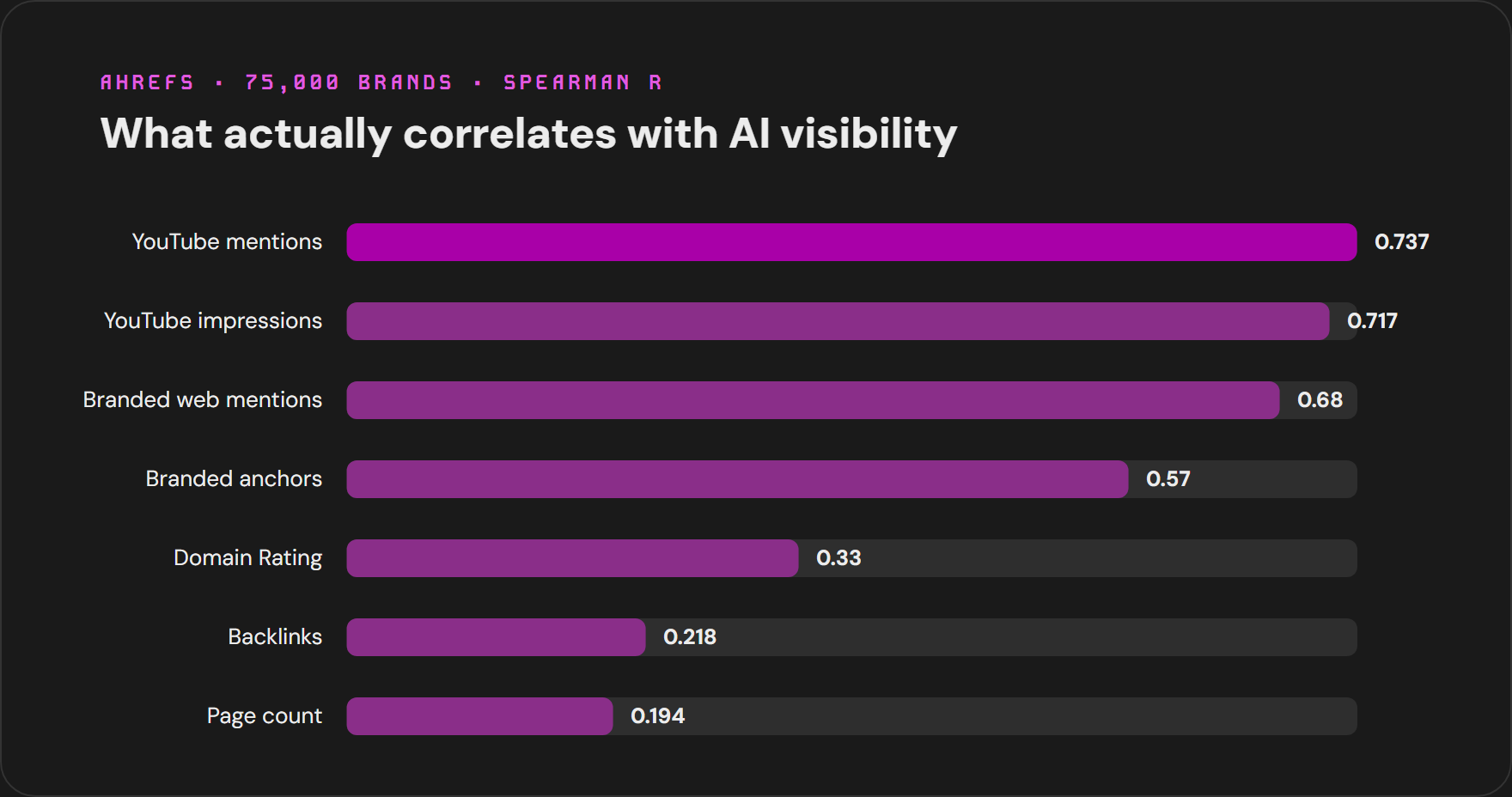
Stats are hard to ignore. The thing SEO has been buying for fifteen years is at the bottom of that list (no surprizes there - I have built a whole ecosystem based on the assumption that links don't matter at all in the post-AI era), and the thing everyone files under "social" is at the top, winning on a metric that has nothing to do with how many people watched.
Stop following gurus and listening to agencies that have something to sell you. Optimize for what works, not what's easier to productize and sell on a retainer ;)


