


Where Claude's web results actually come from, what Anthropic documents, what's still a guess, and how everything together gets your brand, your docs, or your website quoted.
Everyone selling you "AI SEO" (under whatever name...) is guessing. I went and found out how Claude builds an answer, and what was confirmed by Anthropic.
Search used to hand you ten blue links and let you pick the one you wanted. Now the machine reads the pages for you and gives you a single answer, and if your page isn't in it, you're gone. No second place, no page two, nothing. "Optimize for AI" is what people say when they don't know how the thing actually works.
Here's what I could confirm, what Anthropic documents, and what's still a guess.
The short version
- Claude's live web results come from Brave Search. Confirmed by Anthropic's own subprocessor list (March 19, 2025) and by citation-matching tests. Not Google, not Bing. It looks like a plain API customer deal, no exclusivity, no equity. The same API also runs Mistral's Le Chat.
- The model decides when to search, rewrites your question into its own query, can run several searches in a row, and returns inline citations. There is no secret "fan-out template". It writes the queries on the fly - which is great news since there's no secret template for creating fan-out queries.
- Claude searches about 91% of the time, and usually settles it with one good query, not a spray of parallel ones.
- Two factors decide whether you show up: ranking in Brave, then evidence the model can lift at the passage level, meaning stats, quotes, and citations. The Princeton/Georgia Tech GEO study showed 30 to 41% gains from adding meaningful "data" to the page.
- For code and docs, clean chunkable pages plus a real presence on Brave, Stack Overflow (yes, still!), and GitHub do the work. llms.txt doesn't seem to have any impact. Things may change, and it's almost zero effort, so I wouldn't skip that one.
What I Could Confirm
The Brave Relationship
Anthropic never announced who powers Claude's search. People found out anyway. On March 19, 2025, "Brave Search" quietly appeared on Anthropic's subprocessor list, the roll call of vendors allowed to touch Claude's data. Two independent confirmations landed within days.
The first was a citation match. Simon Willison asked Claude to "Search for pelican facts". Claude searched "Interesting pelican facts", and the ten sources it cited were the exact ten you get running that query straight on Brave. The second was a leak: Claude's web search tool carried a parameter literally named BraveSearchParams, which TechCrunch spotted. When your config file names the vendor, the mystery is over :]
A later SEO analysis found Claude's citations lining up with Brave's top organic results far past chance (p < 0.0001 across the test queries). That tells me Claude mostly takes Brave's ranking as given rather than re-ranking hard on its own. Whatever Brave decides is good, Claude mostly agrees with.
Is this a sweetheart deal or is Anthropic just buying the index like anyone else? Everything points to the boring answer: a normal commercial integration on the same Brave Search API any developer can sign up for. No sign of exclusivity, equity, or a custom arrangement. Brave sits on the approved-subprocessor list, queries arrive stripped of personal identifiers, and the same pipe feeds Le Chat. Which matters more than it sounds, because Brave runs one of only three independent web-scale search indexes in the western world, the only one not owned by Big Tech, covering north of 30 billion pages.
So Claude reads Brave's index through Brave's API. It is not out there crawling the open web itself when you chat with it. Get that one fact straight and most of the "how do I optimize for Claude" question answers itself: you optimize for Brave, then you make yourself easy to quote.
What Anthropic Documents About The Mechanism
Anthropic's web search docs lay out a simple loop. Claude looks at your prompt and decides whether to search. If it does, the API runs the query and sends the results back to Claude to process. It can repeat a few times in one turn if needed. Then Claude writes its answer with the sources cited inline.
When it bothers to search, Anthropic's guidance is what you'd expect: recent events, current prices, live scores, anything about a specific company, person, or product that might have moved, and any time you tell it to look something up. It skips the search for stable stuff: settled facts, math, fundamentals, creative writing, and anything already sitting in the conversation. The system prompt can push it either way, but the rule of thumb is - if the model already knows it, there's no reason to search for it on the web.
Dynamic Filtering
The current tool version (web_search_20260209) added dynamic filtering. Claude now writes and runs code to sift the search results before they ever hit its context window, keeping the chunks that matter and throwing out the rest. Cheaper on tokens, and it works especially well for technical docs and citations. It needs the code execution tool switched on.
For anyone trying to get cited, this is what matters. Claude increasingly judges your page at the level of individual chunks, via code, rather than reading the whole thing top to bottom. Your page isn't the unit anymore. Your paragraph is.
Fan-Out Queries
The phrase comes from Google's AI Mode, which shreds one question into a batch of sub-queries and fires them all at once. People assume Claude does the same. It doesn't.
Claude searches one at a time. It runs a query, reads the results, and runs another query only if needed. Closer to a person poking around than spraying queries like a shotgun. There is no published fan-out recipe, because Claude invents each one based on your prompt. When someone sells you "exact fan-out queries Claude uses", you know it's a lie.
Anthropic says simple questions take one to three searches, comparisons and multi-entity research can run ten or more, and research agents get set up for fifteen to twenty. An independent benchmark on questions that genuinely needed current info found the Claude model it tested (Haiku 4.5) searches about 91% of the time, and usually finishes after a single search.
The page you want in the answer has to rank for the clean, reformulated version of the question, the way Claude would phrase it. Find it, and you'll know what to look for instead of trying to "rank" for what "GEO experts" and "AI visibility tools" tell you.
Multi-agent Research
For its deep Research, Anthropic has written up a multi-agent setup that goes well past ordinary retrieval. A Lead Researcher spins up three to five subagents that search in parallel, each firing its own parallel calls, which cuts the wall-clock time by up to about 90% on hard questions. Then a separate Citation Agent runs at the end and checks every claim against its source, so the final answer doesn't invent things or bolt a real citation onto the wrong sentence.
This is the closest Claude gets to real fan-out, and it lives in the Research product, not in every chat. The Citation Agent is the part you should care about: content that's easy to verify against its source is content that survives the check. Content that makes a claim you can't trace gets quietly dropped, no matter how good it sounds.
What Drives Claude Citation
The anchor here is "GEO: Generative Engine Optimization" (Aggarwal et al., Princeton, Georgia Tech, and IIT Delhi, ACM KDD 2024). They tested nine techniques across 10,000 queries, checked the results on Perplexity, and built GEO-bench to measure it properly.
| Technique | Effect |
|---|---|
| Quotation Addition | The single best move. About 41% on position-adjusted word count, 28% on subjective impression. |
| Statistics Addition | About 31% and 23%. Hard numbers give the model discrete, citable units. |
| Cite Sources | Strong on factual questions. Around +115% for pages ranked near fifth. |
| Fluency Optimization | Clear writing. Strongest stacked on top of the above. |
| Authoritative Voice | Confident, evidence-backed tone. |
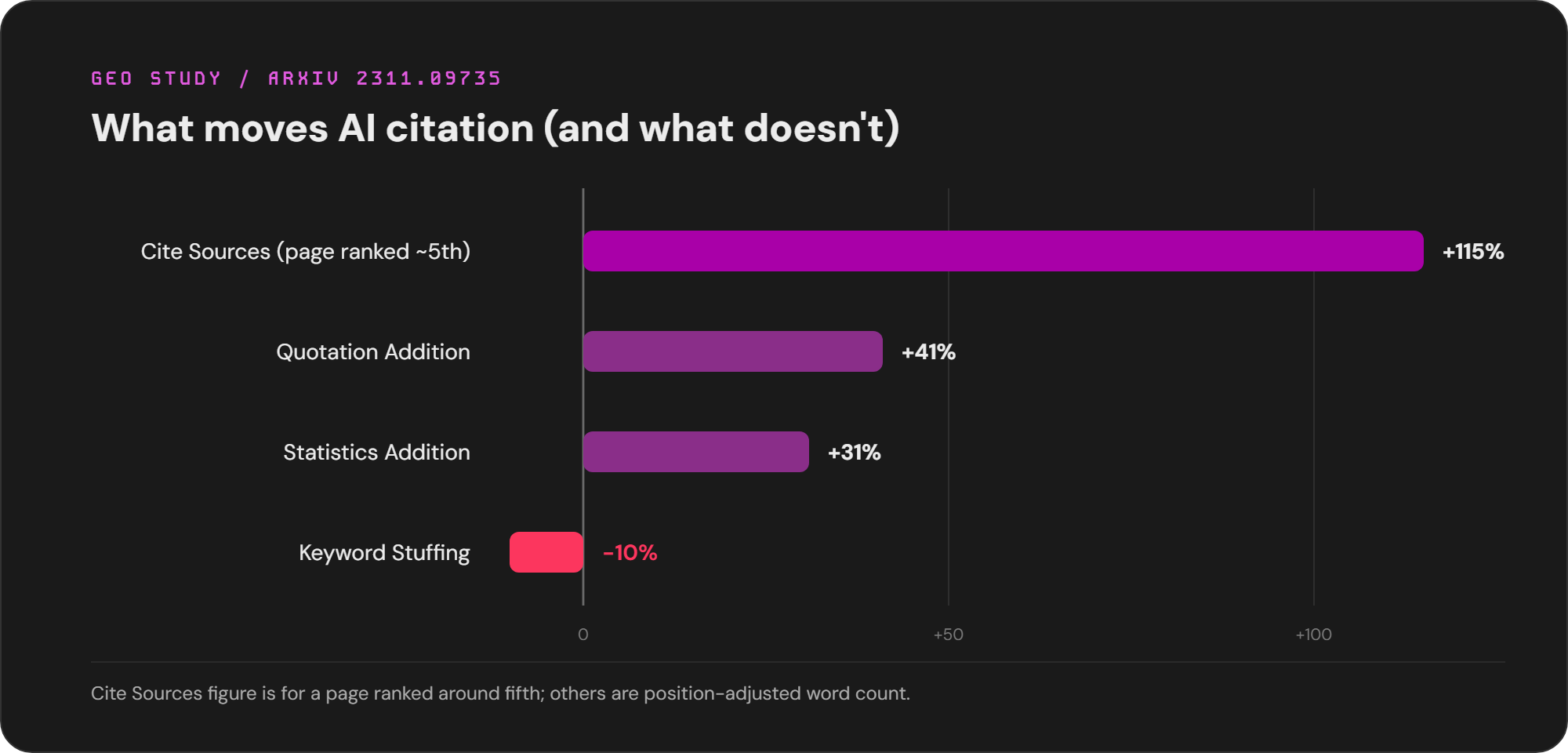
And obvious, but still worth a mention: keyword stuffing landed about 10% below baseline. Adding more words did nothing at all. Classic keyword density "optimization" doesn't do anything for AI visibility.
Look at what every winning technique has in common and the whole game gets simple. They each produce a discrete, verifiable unit the model can lift, attribute, and defend: a named quote, a specific percentage, an explicit citation. Vague qualitative prose gives it nothing to grab. A chunk-ranking pipeline skips it, and a Citation Agent won't use it.
The lower-ranked pages gain the most. A page sitting at fifth position but with citations can leapfrog the top result into the answer. But read the precondition before you get excited: it still had to be on Brave's first page to be in the running at all.
Newer work (AgenticGEO, 2026) splits the two things you're actually chasing, which people constantly blur together. Visibility is how much of your content lands in the answer. Attribution is whether you get named for it. They come apart. You can be used without being credited, and credited without being used much. Track both, because optimizing one tells you nothing about the other.
The Playbook
If you're a brand
Stop thinking in blue-link ranks. The metric is answer share: out of all the relevant prompts, how often you get pulled in, mentioned, or cited against your competitors.
Rank in Brave first. If you're not in Brave's top ten for the reformulated query, you are not in Claude's pool, end of story. Make sure Brave can actually crawl you; its crawler mostly follows Googlebot's rules, so check your robots.txt isn't quietly blocking it. There's no Claude-specific opt-in or submission tool, so you live and die by standard indexing as Brave reads it. This is a whole job on its own, and I wrote the playbook for it separately: how to rank on Brave Search in 2026.
Keep your entity consistent. Say your name, your description, and your category the same way everywhere: your site, Wikipedia, G2, Capterra, your socials. Models read that cross-source agreement as proof you're a real, definite thing. Consistency matters!
Earn outside mentions. Editorial coverage in places with authority, plus a genuine presence on Reddit, Quora, and LinkedIn, which were among the most-cited sources for the big LLMs in late 2025. This is the off-site weight these systems lean on, and it's the part you can't fake from your own domain.
Note: Don't focus on a single source! Those come and go...
Structure the page for extraction. Drop a 40-60 word direct answer right under each heading. Write H2s and H3s as the actual questions people ask. Give every section at least one hard number and the named entities it belongs to.
Lead with evidence. Stats, quotes from named sources, citations to things worth citing, exactly what the GEO study rewarded. Turn every claim that matters into something a machine can pick up and carry.
If you ship docs, frameworks, or libraries
The real question a developer is asking: when someone asks Claude how to do X, will it reach for my library, and will it use it right?
Write clean, chunkable docs. Claude's dynamic filtering and Brave's chunk extraction both reward pages where one concept lives in one self-contained passage: a clear heading, a one-line definition, a working example. Walls of prose lose. JS-heavy doc sites that hide their content behind rendering lose harder, because there's nothing there when the crawler looks.
Format for the code path specifically. Brave's grounding pipeline handles code on purpose, with dedicated code-context extraction and forum-discussion extraction (the Stack Overflow kind). Clean code blocks, honest function and parameter docs, and a real forum presence all feed it.
Keep examples current and unambiguous. Models grab the present-day, copy-pasteable way to do something. A deprecated example is worse than none, because it gets retrieved and then quietly teaches everyone the wrong thing under your name.
Build authority on the code side. GitHub activity, a spot in the tutorials people actually follow, Stack Overflow answer volume, references from other docs that already rank. The Cite Sources effect carries over here too: docs that point at the real specs and RFCs read as more trustworthy.
On llms.txt... The standard, proposed by Jeremy Howard in September 2024, hands an LLM a tidy Markdown map of your docs, and Anthropic, Stripe, Vercel, Cursor, and Cloudflare all publish one. Sounds like a cheat code. It isn't, at least not yet. As of 2026 no major AI provider, Anthropic included, has publicly said it reads the file in production. An SE Ranking study of about 300,000 domains found no statistically significant link between having it and getting cited; when they dropped it from their prediction model, the model got more accurate, which is a polite way of saying it was noise. Of the 50 most-cited domains, exactly one had an llms.txt. An OtterlyAI test logged 84 llms.txt requests out of 62,100 AI-bot visits over 90 days, about 0.1%. So ship it. It's 5min of work, and the IDE agents genuinely do read it, but file it under cheap insurance for a "maybe one day" scenario. Don't auto-generate Markdown copies of every page - all you've built there is a duplicate-content problem, and all agents read your website anyway.
The Chain That Runs Under All of It
Brand, blog, or library docs, the path is the same one:
Be crawlable by Brave, rank in its top results for the reformulated query, put concrete chunk-extractable evidence on the page, survive the verification check, get used and credited.
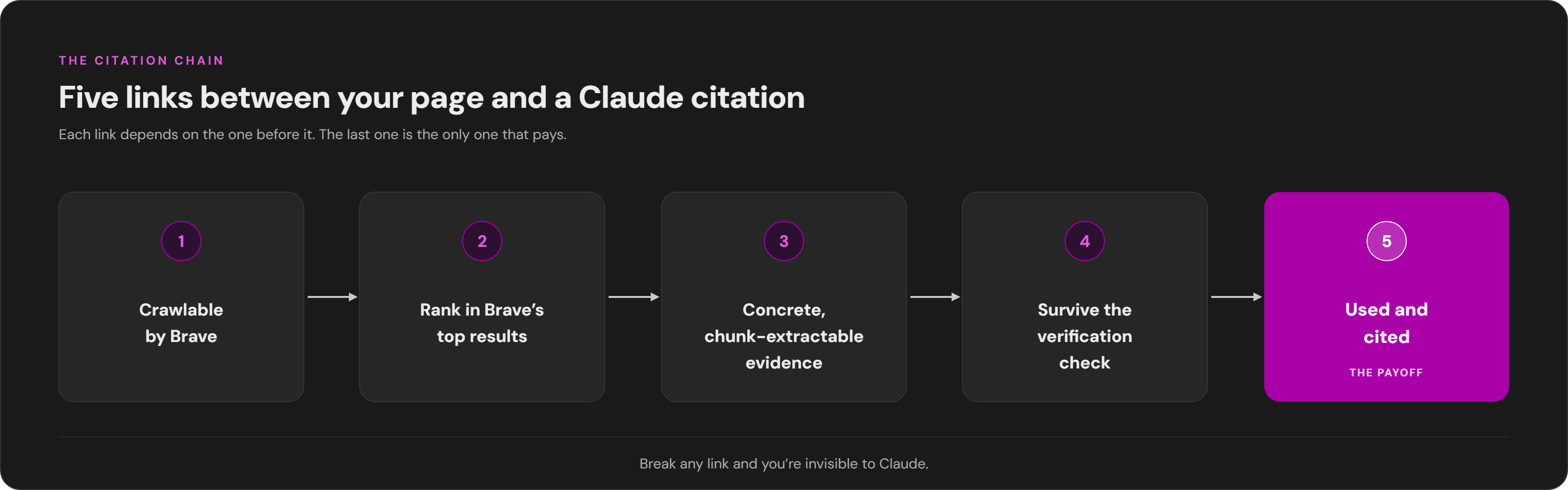
Snap any link in that chain, and you're invisible to Claude, no matter how well the page reads to a human. The writing being good is necessary. It was never sufficient.
What I Couldn't Confirm
I'd rather mark what I know than pretend I'm the all-knowing guru of GEO. A large part of this is still speculation or educated guesses.
Which Brave endpoint Claude.ai uses today, I can't tell you. It could be the plain Web Search API or Brave's newer LLM Context API, launched February 2026, which serves ranked "smart chunks" at under 130ms p90 overhead. The 2025 confirmations predate that endpoint, so a move to richer grounding is plausible. It's just not public. Still... Both are publicly accessible and much more reliable than most of the tools out there.
The exact logic behind Claude's decision to search and the queries it writes isn't published. Anthropic documents the behavior, not the machinery underneath. Anyone describing the internals in detail is reconstructing, and we know that correlation != causation.
I couldn't find any official paper trail about Anthropic's grounding pipeline. What's public is the docs, the Citations API, and the multi-agent write-up. Not filings.
And the citations move. Practitioners report AI citations swinging 40 to 60% month over month, which means the boring work of holding a signal steady over time probably beats any one clever trick you pull once and walk away from.
This isn't a puzzle you solve. It's a position you hold, on a machine that keeps changing its mind about who's worth quoting. I spent twenty years on the previous version of that machine. This one has better manners, faster reactions, and a shorter memory.


